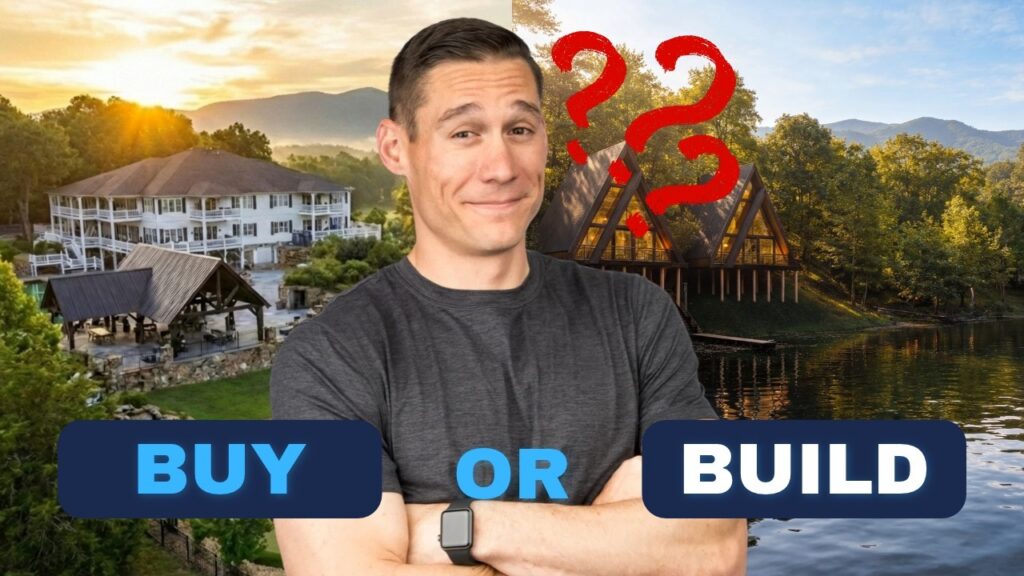
I am buying and renovating a boutique hotel and building one at the same time. The two projects sit about ten minutes apart in the North Georgia mountains: an old lodge in Ellijay that we are turning into a micro-resort, and Willow Falls in Blue Ridge, a landscape resort we are building from the ground up on 22 acres around a private lake. Same market. Same team. Two completely different games.
If you already run a few short-term rentals and keep looking at places like Live Oak Lake or Onera thinking you want to build something like that, this is for you. By the end you will know whether you should buy or build your first boutique hotel or micro-resort, the three questions I would answer before spending a dollar, and a third path most people skip. For the bigger thesis, start with “Boutique Hotel Investing” Explained.
I am Blake Dailey. I bought my first property through a house hack at 22. Since then I have bought and operated eight boutique hotels, including Tremont Lodge, a 130-room resort in the Smoky Mountains of Tennessee. Through Hotel Launch I have helped 30-plus members buy and open their own. I have also spent time with Isaac French, who built Live Oak Lake, and Ben Wolff, who co-founded Onera. Both have spoken at our boutique hotel cons. A lot of what we are doing in Blue Ridge came out of those conversations.
What “buy” and “build” mean here
For this post, buying means taking over a property that already exists: an old motel, a lodge, a cabin resort. You renovate it, reposition it, and relaunch it as a boutique hotel. Building means you start with land, then design and construct the units from scratch. Both can get you to one site, one brand, and enough keys to pay a team so the property does not need you in the middle of every guest issue. The question is which road gets you there with the least risk and the most upside for where you are right now.
Why buying wins for most first-time boutique hotel buyers
Start with buying, because for most first-time buyers it is the smarter move. The Ellijay lodge sat on about seven acres. We bought it and are turning it into a micro-resort that opens this fall. Here is why buying often wins:
- Faster. The building is already standing. On Ellijay we closed, renovated, and relaunched on a much shorter clock than a ground-up build. Willow Falls runs well over a year.
- Less risk. You can walk it, inspect it, and see what you are getting. You avoid a lot of zoning, site work, and build-cost surprises that come with development.
- Usually less capital. You are paying for an asset that exists instead of funding every footing, septic line, and stick of framing.
- Easier lending. Banks understand a building with walls. We used an SBA loan to close Ellijay. Lenders get more nervous about an unproven plan if you do not have construction experience.
There is a bonus when you buy: because something real already exists, you can start selling before you open. We posted renderings of the new amenities on the Ellijay Instagram. Across a handful of posts over about four weeks with zero ad spend, that turned into over 4,000 new followers, 50 qualified leads, and almost $50,000 in group bookings before we opened the doors.
The catch when you buy a boutique hotel
When you buy, you are limited to the box you bought. Room sizes are what they are. You can move some walls. You cannot move the building. That puts a ceiling on upside: a 15-key property is a 15-key business unless you add on. Sometimes the box bites back. Ellijay came with a gorgeous resort-style pool that looked fine. Then the health department decided the river-rock sidewalls were unsafe, so we had to rebuild the pool inside the existing shell. It became the biggest change order on the project. Nobody put that in the listing.
My rule when buying: underwrite conservatively and price in contingency for the unknown. The way around the ceiling is adding experience. At Ellijay we are rebuilding the pool, adding cold plunges, a sauna, event space, pickleball, and a pitch-and-putt on site. Same rooms. More reasons to book. For how experienced buyers stress-test deals, see 7 Red Flags That Kill Boutique Hotel Deals.
Why you build a boutique hotel or landscape resort
Willow Falls is 22 acres on a private lake in Blue Ridge. When we got it, it was a wedding venue with a few outdated cabins. Now we are building treehouses in the canopy, A-frames, mountain-view glass-wall cabins, and lakefront A-frames to turn it into a premium landscape resort. Here is why you build:
- You can create something that does not exist anywhere else. The treehouses sit on piers so guests walk out into the trees with the lake in front of them. The big A-frame has a three-story glass front lined up with the outdoor wedding ceremony site, built to be the bridal suite for a venue doing about 50 weddings a year. You design for that. You do not buy it off the shelf.
- You design the business. Key count, unit mix, amenities, where every unit sits, and how the site is programmed. You design the experience, then price for it.
- Building is how you create a market. Isaac French built Live Oak Lake on about five acres in Waco, Texas: seven Scandinavian-style cabins around a small lake. Waco did not have anything like it. Guests did not just pick Waco and then find him. They came because of what he built. That is the Willow Falls play: build the thing people travel for.
- Development usually has the highest returns because you create the value. The gap between what it costs to build something great and what it is worth once it is open and performing is profit you keep. When you buy, you pay the seller for most of that value.
Onera, Ben Wolff’s landscape resort in Fredericksburg, Texas, opened in November 2021 with 11 units. About a year later Summit Hotel Properties, a public hotel REIT, bought 90% at a $5 million valuation. Their filing showed roughly $440 RevPAR in 2022 with margins around 60%, which Ben confirmed. It was the first standalone glamping investment by a public REIT. Those two projects informed the experience we are building at Willow Falls.
The downside of building
Building costs more. Every unit is new money: foundations, utilities, roads, septic. On the big A-frame we chose a fabricated steel wall for the glass front for strength, and it cost more than a framed truss wall. You make a hundred little calls like that. Costs can inflate. It is riskier on a first project. What stalled Willow Falls was septic, lot lines, topography, soil tests, setbacks from the lake, and the three springs that feed it. Those decided where new cabins could go. A power line sat across the best high ground with the best views, too low to drive under, so we buried it and turned that corridor into the road to the mountain-view cabins. Permits, engineering, and a wet summer pushed framers back. New units make no revenue until they are built and open.
How we handle it: every unit type gets designed and permitted on its own track, then we build like an assembly line. Clear the next site while the last one gets foundation and the one before that gets framed. You can open sooner and start getting paid while the rest goes up. If you are looking at land, the dirt decides. Before you fall in love with a site, find out where septic can go, where power and water come in, and how guests reach every unit. For financing context, see How to Get a Boutique Hotel Loan.
The third path: buy something that already makes money, then build on it
At Willow Falls we did not buy completely raw dirt. We bought a working wedding venue booking roughly 20 weddings a year and we are building a resort around that. The existing business carries the property while new units go up. At Ellijay we bought an existing lodge and we are building amenities around it that drive revenue higher than the rooms alone. That is the third option: buy something that already makes money, then build on it. You get the lower risk and easier lending of an existing building with the upside of creating something new. For most people I work with, that is the best play.
Three questions before you spend a dollar
- What can you fund, and how long can you carry it? Can you and your partners carry a project with no revenue for 12 to 18 months? If that makes your stomach drop, buy, or buy and build on something that already produces income.
- Have you done this before, and do you have a team? If you do not already have an architect, builder, and engineer you trust, buying lets you learn hotel operations before you take on construction risk.
- What does your market need? If it already has what you want to offer, buy one and do it better. If there is a gap, like Waco before Live Oak Lake or Blue Ridge before Willow Falls, that is a reason to build.
Whichever way you go, validate the revenue first. This is the step I see people skip most often. They nail financing and deal structure, then never prove what the property can make, what it costs to get there, and whether it still pencils after contingency. For a full buy path, see How to Buy Your First Boutique Hotel.
Buy or build: the short answer
Buy for speed, easier lending, and lower risk. Build when you can create something one of a kind and handle the time and cost for more upside. Best of all, find a deal that lets you do both. We are documenting Ellijay and Willow Falls as we open them, wins and problems included, on the YouTube channel above.
FAQ
Should I buy or build my first boutique hotel?
Most first-time buyers should buy an existing lodge, motel, or cabin resort and renovate. Build when you can carry a longer timeline, have a team, and your market has a clear gap.
What is the third path between buying and building?
Buy a property that already makes money, then add units or amenities. That is what we are doing at Willow Falls (wedding venue plus new landscape resort units) and at Ellijay (existing lodge plus new amenity stack).
Why is buying a boutique hotel usually less risky?
You can inspect a standing building, lenders understand it better, capital is often lower, and you can start marketing before you open.
When does building a boutique hotel make sense?
When you need a product that does not exist in the market, you want full control of key count and experience, and you can fund and carry construction until units open.
Where should buyers go next?
If you are actively buying or building your own boutique hotel: Hotel Launch. If you are still deciding: BlakeDailey.com/start-here-page.
Ready to buy, build, or buy-and-build your own boutique hotel? Hotel Launch. Still mapping whether boutique hotel investing is your next move? Start here.